
She would be the first Indian to be occupying the coveted post at IMF after former RBI governor Raghuram Rajan

Ahead of India's annual budget presentation next week, IMF's chief economist Gita Gopinath has favoured the extension of the pandemic support measures, thrust on investment in infrastructure and expanding health sectors programmes like Ayushman Bharat, and a very credible divestment path for commercially viable companies. The Indian government has provided a lot of schemes for small and medium enterprises, most of which is in the form of liquidity support, Gopinath told PTI on Tuesday. "And you want to revisit it and see how effectively that is working and see whether additional support may need to be provided," she said while responding to a question on her recommendations to Finance Minister Nirmala Sitharaman, ahead of her presentation of the annual Union Budget on February 1. It would be a good time for banks and Non-Banking Financial Companies (NBFCs) to raise capital given the attractiveness of financing conditions at this point, she said.

With this subdued forecast, India is likely to record its worst growth performance since the 1991 liberalisation. However, it is among the only two major economies, which will register a positive growth rate in 2020. The other being China, for which the IMF has projected a growth rate of 1.2 per cent.
Amid slowing growth and low interest rates, investors will need to focus on stock-picking, suggests John Remmert.

India's foreign exchange reserves are at an all-time high.

India's rank in the World Bank's ease of doing business index cannot get better unless more attention is paid to bringing about procedural reforms in the way states run their governments and provide various approvals for trade and industry, says A K Bhattacharya.

Opportunity for India to take leadership in economic diplomacy.

'The history of Moody's India ratings tells its own story,' points out T N Ninan.

Jaitley said each of the regions in the world is trying to do its best.

Indian economy is expected to expand at 8.5-9 per cent over 10-15 year time frame once the structural issues hampering growth are addressed by the government.

There are various projections about India's growth.
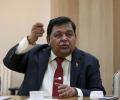
Larsen & Toubro (L&T), India's largest construction and engineering player, has lost as many as 14 large orders in the country because companies that don't possess adequate technical expertise and experience, of late, have won the projects by bidding lower, claimed A M Naik, non-executive chairman of L&T. But the company has made up for the losses by winning projects overseas, where it has acquired a sizeable market share amid tough competition from large global players, he said.

The former RBI deputy governor talked about the prospects of an economic revival, reforms in IMF, etc.

India has undertaken a number of structural reforms.

Soon after Prime Minister Modi's assertion, the G20 countries also came down heavily on terrorism.

'Although mid- and small-cap funds have the potential for higher growth, they come with inherent higher volatility.'

The ministry sought to allay the rating agency's concerns and said economic growth was on an upward swing.

Group still far from coordinating monetary/forex policy

The PM said there was a need to tackle the problem of terrorism in an organised manner.
UPA-II has yielded a 7.5 per cent average annual growth rate

Emerging markets such as India have always run higher inflation rates than developed economies such as the US and countries of Western Europe. But for the first time in the past 30 years, the US reported a higher consumer price inflation (CPI) rate than India in five consecutive months. The US reported a CPI rate of 7.5 per cent in January 2022 against 6.01 per cent in India and analysts expect the trend to continue for at least a few months more

The keynote address will be given by United States President Donald Trump

The steep decline in commodity prices has reversed.

Thinking big, China is changing the world order; with mixed priorities, we can but tag along, writes T J S George.

Countries with abundant resources are faring worse in terms of development than those with less.

EU authorities made a last-minute offer to salvage a bailout deal that could keep Greece in the euro as the clock ticked down on Tuesday, with Germany warning that time had run out to extend vital credit lines to Athens.

The laggards in the Sensex kitty were Vedanta, Tata Steel, M&M, HCL Tech, Bharti Airtel, Maruti Suzuki, L&T, Asian Paint and HDFC

Devangshu Datta predicts the good, the bad and the ugly of currency trends for the coming year.

The government is seeking to keep its fiscal deficit within the budgetary target of 4.8 per cent of GDP.

IMF says, India will grow significantly in near-term.

Capital flows have become much more skittish and volatile during this period, with short-term horizons dominating allocations.
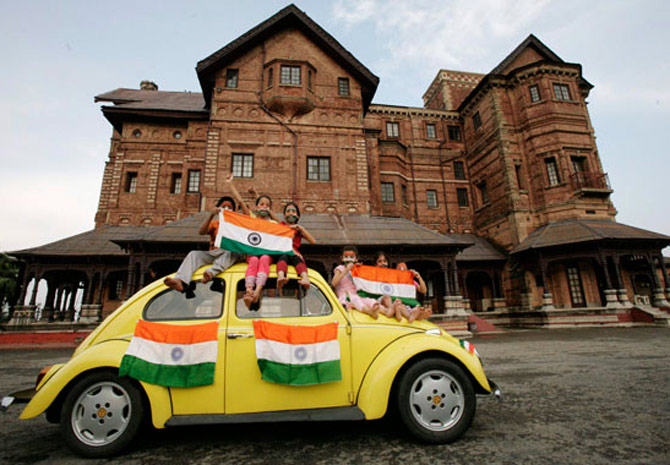
The poll of over 30 economists, taken in the past week, showed Asia's third largest economy will expand 7.8 percent in the fiscal year ending March 2017.

"So you will not have anything better... democracy loving, capitalist respecting environment... in India," Sitharaman said at the event hosted by the Federation of Indian Chambers of Commerce and Industry in association with the US India Strategic and Partnership Forum.

It is a wonder how pervasive and long-lasting the damage can be from a balance-sheet crisis, says Suman Bery.

There has been a welcome focus on fundamental reforms, time-bound programmes that fix accountability and the use of technology. The upcoming Budget could build on these initiatives, says Abhas Jha.

What the reserves offer for now is improved import coverage of about 13 months, almost double the 2013 level of less than seven months. And, ammunition to arrest a rapid rupee slide, says Anup Roy.
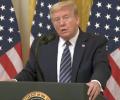
The coronavirus has infected 1.2 million Americans and killed more than 73,000.

'A balanced head plus heart approach would be a full opening up of the economy including manufacturing and internal travel in the country but excluding COVID-19 hotspots,' recommends Jaimini Bhagwati.

The Reserve Bank on Wednesday allowed inbound travellers from G20 nations arriving at select airports to use the popular UPI for making payments in the country. Later, the RBI also proposes to extend the Unified Payments Interface (UPI) facility to travellers from all countries. UPI is a system that powers multiple bank accounts into a single mobile application, merging several banking features, seamless fund routing & merchant payments into one hood.

The road ahead for the markets in the short term will depend on external factors rather than domestic developments.
